 China printing machine manufacturer
PET Cup Printing Machine by offset printing,screen printing and digital printing
Comparison of Automatic Curved Offset, Curved Screen, and Digital Printing Technologies for Disposable PET Cups
Abstract
Disposable polyethylene terephthalate (PET) cups are widely used in beverage, fast food, and retail packaging due to their light weight, transparency, safety, and recyclability. High-quality surface decoration is critical for brand identification, information communication, and product differentiation. Three mainstream automated printing solutions—automatic curved offset printing, automatic curved screen printing, and direct-to-cup digital printing—are widely applied in PET cup manufacturing. This paper analyzes the working principles, core advantages, limitations, and application scenarios of each technology, providing a reference for equipment selection, process optimization, and production planning in the packaging printing industry.
1 Introduction
The global market for disposable plastic packaging continues to expand, and PET cups represent one of the most consumed single-use containers. Printing on curved, non-absorbent PET surfaces requires high adhesion, color fastness, scratch resistance, and compliance with food-contact regulations. Traditional manual printing suffers from low efficiency, unstable quality, and high labor costs; automated curved-surface printing systems have become the standard for mass production. Among them, curved offset, curved screen, and digital printing differ significantly in ink transfer, plate making, speed, cost, and graphic capability. Clarifying their technical differences helps enterprises match processes with order volume, design complexity, delivery time, and budget.
2 Automatic Curved Offset Printing for PET Cups
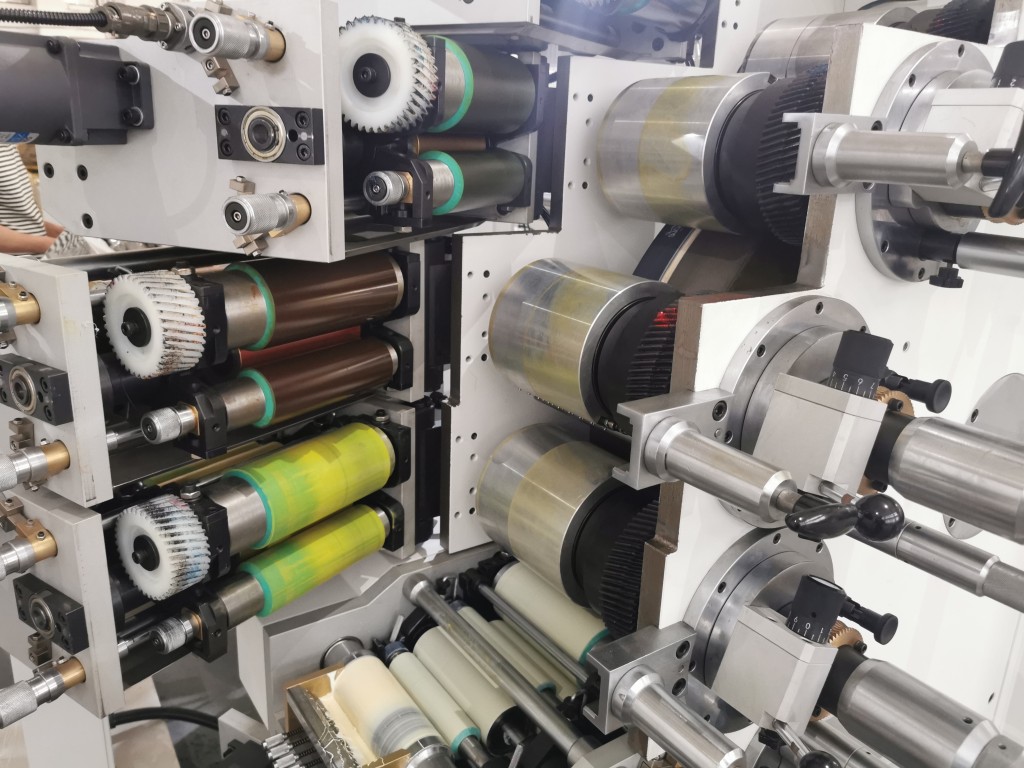
2.1 Working Principle
Automatic curved offset printing (often dry offset) adopts indirect transfer: ink is first transferred from a metal plate to a rubber blanket cylinder, then to the rotating PET cup surface. Most systems integrate corona surface treatment to raise surface energy and improve ink adhesion, followed by instant UV curing to ensure fast drying and firm bonding. Multi-color units (4–8 colors) enable one-pass full-color printing at continuous high speed.
2.2 Advantages
- High precision and fine detail: Stable dot reproduction supports complex graphics, fine text, gradients, and halftones with consistent color accuracy.
- High production speed: Up to 200–350 cups per minute, suitable for large-batch long-run orders.
- Good durability: UV-cured ink offers strong rub resistance, light fastness, and temperature tolerance.
- Cost efficiency at scale: Low per-unit cost for high volumes; low ink waste and stable operation.
- Mature food-safe solutions: Compatible with food-grade UV inks and low-VOC processes.
- Mass production ability:especially for printing multi color circularlly around PET cup.
2.3 Disadvantages
- High setup cost: Requires plate making, color registration, and mold adjustment; long preparation time.
- Poor short-run economy: High plate and labor costs make it uneconomical for small batches.
- Limited ink film thickness: Lower opacity than screen printing for solid blocks on transparent PET.
- Higher equipment investment: Multi-color automatic lines require greater capital expenditure.
2.4 Typical Applications
Large-scale branded beverage cups, chain store standard cups, high-volume promotional cups, and multi-color fine-printing packaging.
3 Automatic Curved Screen Printing for PET Cups
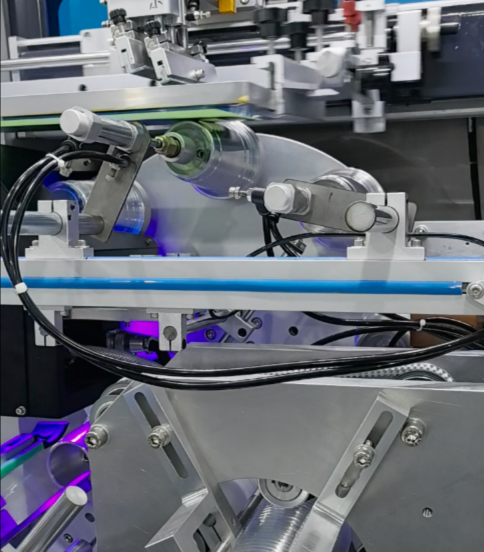
3.1 Working Principle
Automatic curved screen printing uses a stencil mesh; ink is squeezed through the image area by a squeegee onto the rotating PET cup. The curved screen matches the cup contour for uniform coverage. Systems usually include auto-loading, registration, printing, UV curing, and unloading, with servo control for precision.
3.2 Advantages
- Thick ink film and high opacity: Excellent coverage on transparent or colored PET; strong solid colors and metallic effects.
- Strong adhesion and durability: Outstanding scratch, friction, and water resistance; ideal for outdoor and disposable use.
- Good adaptability: Suitable for tapered and cylindrical cups; compatible with various inks (UV, solvent-based, water-based).
- Moderate speed and cost: Speed ranges from 1,600 to 5,000 cups per hour; lower setup cost than offset.
- Simple maintenance: Stable structure, easy screen replacement, and low failure rate.
3.3 Disadvantages
- Limited detail capability: Poor performance for fine lines, small text, gradients, and photographic images.
- Multi-color complexity: Each color needs a separate screen and registration; difficult for high-color-count jobs.
- Ink waste: Higher ink consumption compared with offset.
- Slow color change: Screen cleaning and replacement extend job changeover time.
3.4 Typical Applications
1–3 color logo cups, solid-color brand cups, high-opacity text/graphic cups, and medium-volume standard orders.
4 Direct-to-Cup Digital Printing for PET Cups
4.1 Working Principle
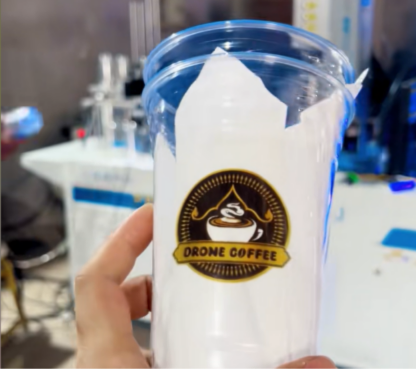
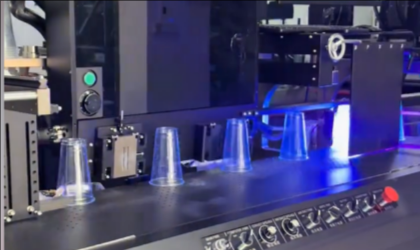
Digital printing uses piezoelectric inkjet heads to directly eject UV-curable ink onto the rotating PET cup based on digital files. No plate or screen is needed; data are directly sent to the printer. Integrated corona treatment and instant UV curing ensure adhesion and fast drying.
4.2 Advantages
- No plate or screen: Zero prepress cost; ultra-fast job changeover.
- Short-run & on-demand friendly: Economical for small batches, samples, and personalized versions.
- Photorealistic quality: Supports 1200+ dpi resolution, full-color images, complex gradients, and variable data (names, codes, dates).
- High flexibility: Quick design revisions; supports multi-version small-batch production.
- Low waste: Ink is jetted on demand; reduces material waste.
4.3 Disadvantages
- Lower production speed: Slower than offset and screen for mass production if do circular printing
- Higher per-unit ink cost: Less cost-effective in very large runs.
- Moderate durability: Ink film is thinner; scratch resistance is lower than screen printing in harsh handling.
- High equipment investment: Industrial digital printers require significant upfront capital.
4.4 Typical Applications
Custom event cups, small-batch promotional cups, sample testing, personalized packaging, and multi-SKU short runs.
5 Comprehensive Comparison
| Item | Curved Offset Printing | Curved Screen Printing | Digital Printing |
|---|---|---|---|
| Detail Performance | Excellent (fine dots/text) | Medium (solid blocks only) | Outstanding (photo/gradient) |
| Ink Film & Opacity | Medium | High (thick film) | Low to medium |
| Production Speed | Highest | High | small logo(fast) Circular (very slow) |
| Setup Time | Long | Medium | Very short |
| Short-Run Cost | High | Medium | Low |
| Long-Run Cost | Low | Medium | High |
| Design Flexibility | Medium | Low | Highest (variable data) |
| Durability | Good | Excellent | Good (with treatment) |
| Equipment Investment | High | Medium | High |
| Suitable Order Volume | Extra-large batch | Medium–large batch | Small–medium batch, samples |
| Maintenance cost | Medium | Low | Very Expensive(the printing head is almost 1/10 cost of machine) |
6 Conclusion
For disposable PET cup printing, the three automated technologies have clear positioning:
- Automatic curved offset printing is preferred for extra-large batches, high detail, and long-run cost efficiency.
- Automatic curved screen printing excels in solid colors, high opacity, and medium-to-large batches requiring durability.
- Digital printing dominates small batches, personalization, rapid proofing, and multi-version production.
With trends toward customization, short-cycle delivery, and green production, digital printing will grow rapidly, while offset and screen will remain irreplaceable for mass production. The optimal choice depends on order quantity, graphic complexity, delivery time, quality requirements, and budget. In future applications, hybrid systems combining digital and traditional processes may further improve flexibility and efficiency for PET cup decoration.

WeChat
Scan the QR Code with wechat